Expert Chartered Accountant
& Financial Advisory Services
CA Nainit Savla provides end-to-end Tax, Audit, Compliance, NBFC, NRI Taxation, and Business Advisory services — helping individuals, startups, and enterprises stay financially organised and legally compliant.
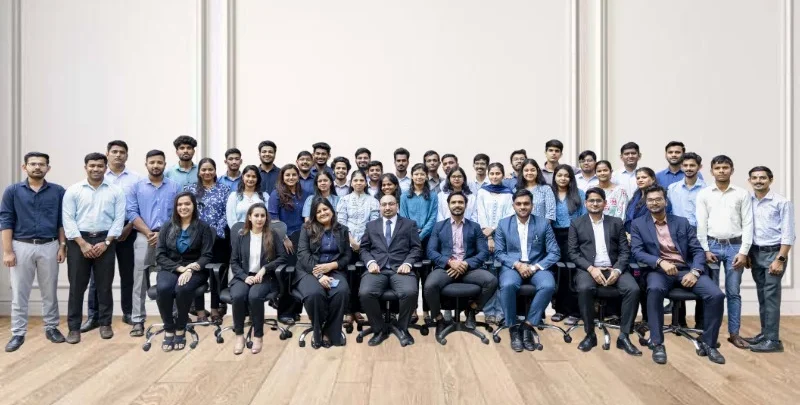
Qualified CA with expertise across direct taxation, FEMA, RBI regulations, and corporate law
Digital-first approach — secure portals, online meetings, automated reminders for seamless compliance
Serving Mumbai, Hyderabad & beyond — clients from across India and NRIs globally
Your Trusted Partner for Financial Clarity
CA Nainit Savla is a full-service Chartered Accountancy firm led by a qualified CA with deep expertise in Indian taxation, regulatory compliance, and business advisory. We serve individuals, startups, SMEs, and large enterprises with transparent, accurate, and timely financial solutions.
Our mission is simple — simplify finance and compliance for every client so that business owners can concentrate on growing their business while we take care of the numbers with integrity.
Comprehensive CA Services Under One Roof
From GST registration to NBFC compliance, audit to NRI advisory — we cover every financial need of modern businesses and individuals.
End-to-end GST registration, return filing (GSTR-1, 2A, 2B), reconciliation, audits, and advisory for businesses across India.
Accurate ITR filing, tax planning, TDS compliance, assessments, and strategic direct tax advisory for individuals, firms & companies.
Statutory, internal, concurrent, GST, and trust audits — along with IFRS/Ind AS implementation and risk control matrix services.
Complete NBFC setup, takeover, account aggregator compliance, FIU-IND registration, CKYCR, and legal support services.
Tax filing, property advisory, repatriation, FEMA compliance, FDI filings with RBI, FLA returns, and citizenship planning for NRIs.
Private Ltd, LLP, Partnership, Section 8, Indian Subsidiary, Foreign Branch — full company formation and ROC compliance services.
Corporate governance, forensic investigations, anti-bribery assessment, supply chain risk, BPR, and SOP implementation services.
Gratuity trust registration, annual compliance, IT approvals, trust deed amendments, and group gratuity trust management.
Independent M&A support — due diligence, valuation, deal structuring, regulatory advisory, and post-merger integration.
Our Simple, Transparent Process
We follow a structured, client-first approach — from understanding your needs to delivering ongoing strategic support.
Understanding Your Needs
We begin by learning about your business, financial goals, and specific compliance or advisory requirements through a free consultation.
Reviewing Financials & Documents
Our team analyses your existing records, filings, and structure to identify gaps, risks, missed deductions, or opportunities.
Planning & Execution
We create a tailored action plan — from ITR filing to GST setup or audit — and execute it accurately, on time, every time.
Regular Updates & Communication
You receive timely status reports, compliance reminders, and direct access to our team — no chasing, no guesswork.
Review & Continuous Support
We don't stop at compliance. We review outcomes, plan ahead with strategic insights, and support your business through every growth phase.
Get Started Today
Ready to simplify your finances and stay stress-free on compliance? Book your free consultation with CA Nainit Savla.
Contact Us →What Makes CA Nainit Savla Different
Experienced, Qualified Professionals
Our team brings decades of expertise in taxation, accounting, regulatory compliance, and business advisory — backed by continuous professional development.
End-to-End Services Under One Roof
From GST and ITR to NBFC registration, NRI taxation, and M&A advisory — everything your business needs, handled by one trusted team.
Fully Transparent Process
No hidden fees, no surprises. You always know what's happening at every stage — clear timelines, clear costs, clear communication.
Tech-Driven, Digital-First Approach
Secure digital documentation, online meetings, and automated compliance reminders — making finance hassle-free from wherever you are.
Personalised, Client-Centric Mindset
Every client — individual or enterprise — gets dedicated attention. We take time to understand your goals before recommending solutions.
Proven Trust Across India & Abroad
Hundreds of satisfied clients — residents, NRIs, startups, and corporates — trust us for timely, accurate, and result-oriented financial services.
Ready to Get Started?
Whether you're a first-time entrepreneur, an NRI managing Indian assets, or a growing business needing compliance support — we're here to make it simple.
Call us directly:
+91 982 1832 683Email us:
nainitsavla@savlagroup.inGot Questions? We Have Answers
CA Nainit Savla offers GST Registration & Return Filing, Income Tax Filing & Advisory, Statutory & Internal Audit, NBFC Registration & Compliance, Company Incorporation (Pvt Ltd, LLP, Section 8), NRI Taxation & FEMA Advisory, Risk Advisory, Mergers & Acquisitions, Gratuity Trust Services, and Family Office Services — all under one roof.
Contact CA Nainit Savla at +91 9167058000 or info@canainitsavla.com to start your GST registration. Our team guides you through document requirements, portal application, and ensures your GSTIN is obtained accurately within 3–7 working days with zero errors.
Yes. We provide complete NRI services — Income Tax Filing for NRIs, FEMA compliance, FDI advisory, property purchase/sale advisory in India, repatriation of funds, FLA return filing, and citizenship & residency planning. All services are delivered digitally for NRI clients worldwide.
CA Nainit Savla handles end-to-end company incorporation — name reservation on MCA, DSC & DIN for directors, drafting MOA & AOA, and SPICe+ form filing. The process typically takes 7–15 working days depending on document readiness and MCA processing time.
An NBFC (Non-Banking Financial Company) is regulated by the Reserve Bank of India. CA Nainit Savla provides complete NBFC services: eligibility assessment, RBI application preparation & submission, NBFC takeover advisory, CKYCR & FIU-IND registrations, and ongoing annual compliance management.
We handle all business tax compliance — advance tax calculations, quarterly TDS return filing, annual ITR for companies/LLPs/partnerships, GST returns (GSTR-1, GSTR-3B, GSTR-9), VAT, Professional Tax, and proactive tax planning to legally minimise your liability year-round.
Yes. We operate a fully digital-first model. Clients consult via video meetings, submit documents through our secure client portal, receive automated compliance reminders, and get real-time progress updates — no in-person visit required, serving clients across India and globally.
Our fees are transparent, competitive, and customised by service type and complexity. There are absolutely no hidden charges. During your free initial consultation, we provide a clear written fee proposal before any engagement or work begins.
CA Nainit Savla serves clients across Mumbai (Andheri, Bandra, BKC, Borivali, Thane, Lower Parel, Nariman Point, Worli, Dadar), Hyderabad (Banjara Hills, Jubilee Hills, Gachibowli, HITEC City, Secunderabad, Kondapur), and NRI clients across the globe through our fully digital service model.
Book your free consultation by calling +91 9167058000, emailing info@canainitsavla.com, or filling out the contact form at canainitsavla.com/contact/. We respond within 24 hours on business days. The first consultation is completely free with no obligation.
Take the First Step Toward Financial Peace of Mind
Whether you need GST registration, income tax filing, an NBFC licence, or comprehensive audit services — CA Nainit Savla is your trusted partner. Book a free consultation today.
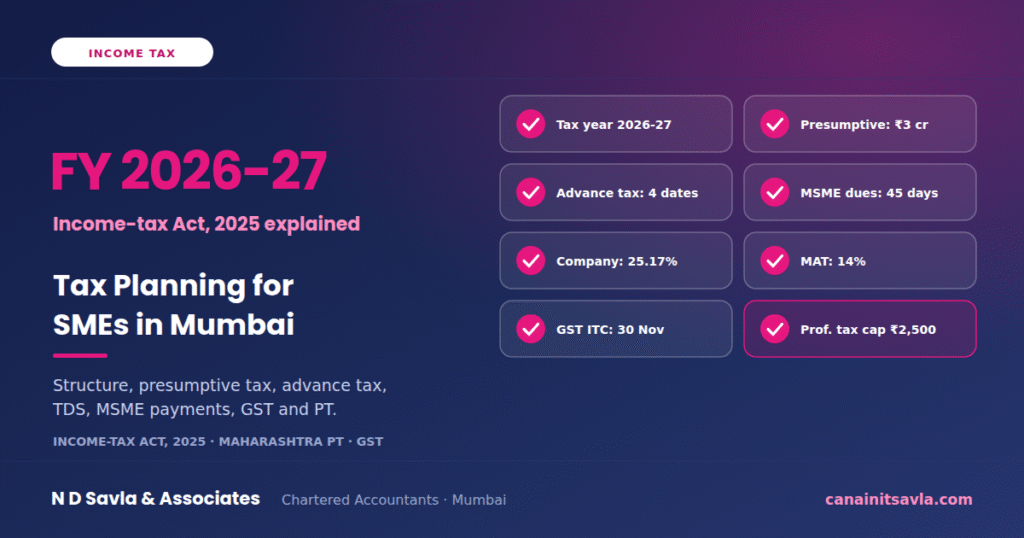
Tax Planning for SMEs in Mumbai: A Complete Guide for FY 2026-27
💰 Income Tax 23 October 2026 · 13 min read Home › Blog › Tax…
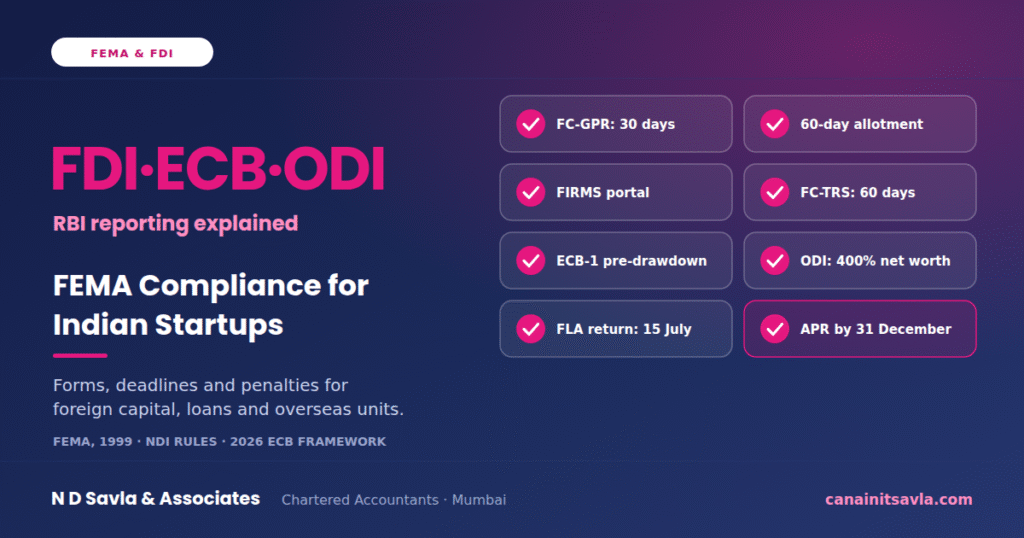
FEMA Compliance for Indian Startups: FDI, ECB, ODI & RBI Reporting Explained
💱 FEMA & FDI 22 October 2026 · 12 min read Home › Blog ›…
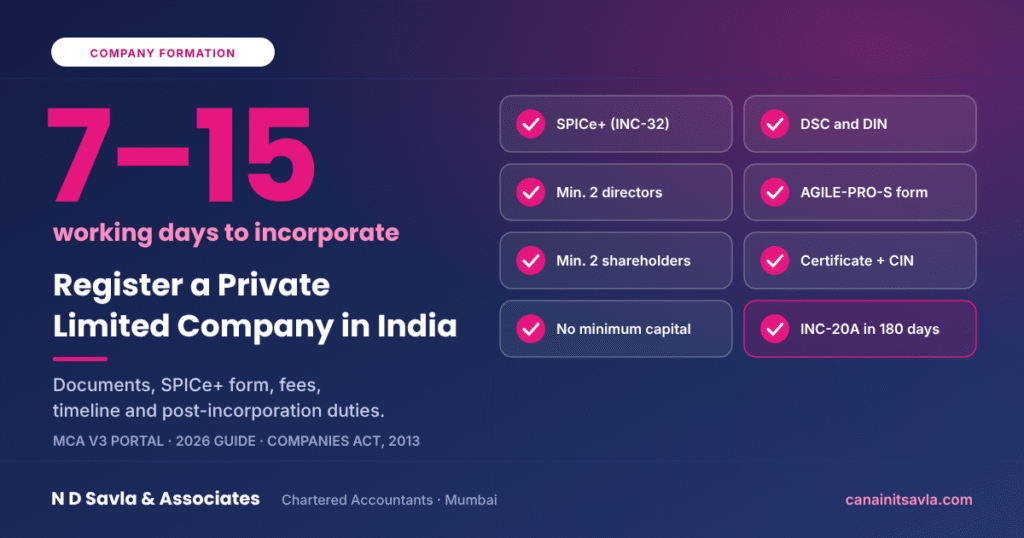
How to Register a Private Limited Company in India: Complete 2026 Guide
🏢 Company Formation 21 October 2026 · 10 min read Home › Blog › Company…