Uncategorized

Other Comprehensive Income (OCI): What It Is and Why It Matters

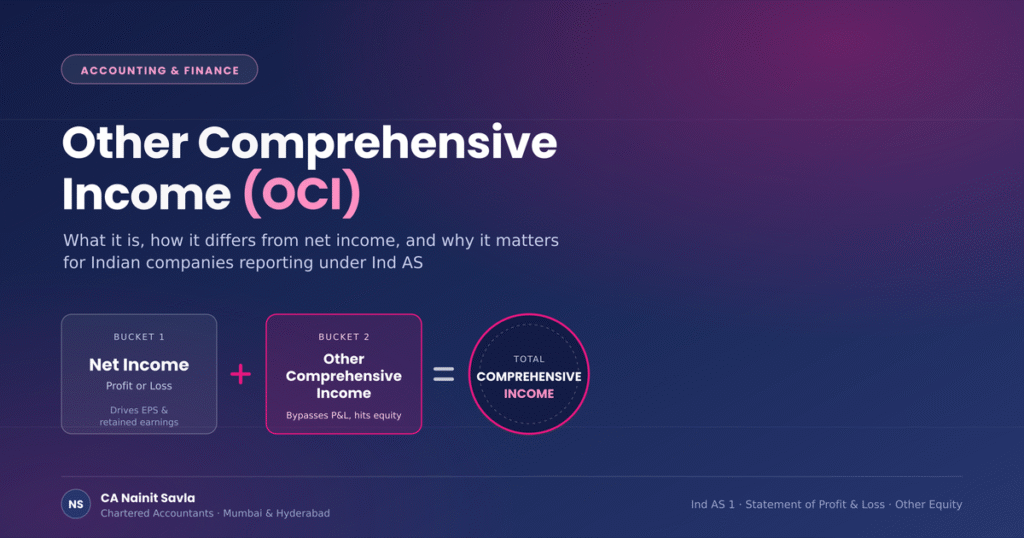
Other Comprehensive Income (OCI): What It Is and Why It Matters | CA Nainit Savla πŸ“Š Accounting & Finance 25 August 2026 Β· 10 min read Home β€Ί Blog β€Ί Accounting & Finance β€Ί Other Comprehensive Income (OCI) Other Comprehensive Income (OCI): What It Is and Why It Matters A 2026 guide by CA Nainit Savla, Chartered Accountants, Mumbai & Hyderabad β€” what OCI covers under Ind AS, how it differs from net income, and why it matters for Indian companies. NS CA Nainit Savla Chartered Accountants β€” Mumbai & Hyderabad β€’ Published 25 Aug 2026 BUCKET 1 Net Income Profit or Loss Drives retained earnings & EPS BUCKET 2 Other Comprehensive Income Bypasses P&L, moves into equity TOTAL COMPREHENSIVE INCOME Ind AS 1 Β· Statement of Profit & Loss Β· Other Equity Β· Statement of Changes in Equity Other comprehensive income is the section of a company’s financial statements that records specified gains and losses that Ind AS keeps separate from profit or loss, even though they still change total equity. Understanding other comprehensive income India rules matters because, under the Indian Accounting Standards notified by the Ministry of Corporate Affairs under the Companies Act, 2013, every company that prepares Ind AS financial statements presents other comprehensive income as a distinct section within the Statement of Profit and Loss, right after the profit or loss for the year. Items such as revaluation surplus on property, actuarial gains and losses on retirement benefit obligations, fair value gains on certain financial instruments, and foreign currency translation differences all flow through other comprehensive income rather than the regular profit and loss account. For finance teams, auditors, and business owners, understanding other comprehensive income matters because it changes how the true financial position of a company should be read β€” a business can report a modest net profit while still carrying meaningful OCI movements that affect net worth, loan covenants, and how investors judge financial strength. What Is Other Comprehensive Income and How Is It Different From Net Income? Other comprehensive income is the set of gains and losses that Ind AS specifically requires to bypass the profit and loss account and instead move directly into equity, while net income reflects the operating and non-operating results a company earns through its ordinary business activities during the year. This is the central point in any comparison of OCI vs net income: net income (also called profit for the year) is what flows into retained earnings and drives earnings per share, while other comprehensive income sits in a separate reserve within other equity until it is either reclassified or permanently retained there. A simple way to think about what is OCI in accounting is to picture two buckets under total comprehensive income β€” one bucket for realised, operating results, and a second bucket for specified unrealised or non-operating movements that accounting standards do not want distorting the reported profit figure. Both buckets matter to a complete financial picture, but only the first bucket, net income, is used for profitability ratios such as return on equity based on profit, or for dividend distributable profits under the Companies Act, 2013. For example, if a manufacturing company revalues its factory building upward under the revaluation model in Ind AS 16, the resulting gain does not appear as profit. Instead, it is recognised in other comprehensive income and accumulated in a revaluation reserve, because the gain has not been realised through an actual sale. What Items Are Included in Other Comprehensive Income Under Ind AS? The items included in other comprehensive income under Ind AS are specifically listed within the applicable standards rather than left to management discretion, and each item is tied to a particular Ind AS. Revaluation surplus on property, plant and equipment recognised under the revaluation model permitted by Ind AS 16, arising when an asset’s fair value exceeds its carrying amount. Actuarial gains and losses on defined benefit plans such as gratuity, required to be remeasured and recognised in OCI under Ind AS 19, rather than smoothed through profit or loss. Fair value changes on equity instruments designated at FVTOCI under Ind AS 109, an irrevocable election available for non-trading equity investments. Fair value changes on debt instruments held under a FVTOCI business model under Ind AS 109, where both collecting contractual cash flows and selling the asset are part of the business objective. Gains and losses on effective cash flow hedges, recognised in OCI until the hedged transaction affects profit or loss. Foreign currency translation differences on foreign operations, arising when a parent consolidates a subsidiary whose functional currency differs from the group’s presentation currency, governed by Ind AS 21, and accumulated in a foreign currency translation reserve. Changes in the fair value of a financial liability attributable to changes in the entity’s own credit risk, where that liability is designated at fair value through profit or loss under Ind AS 109. πŸ“‹ Note Every item in other comprehensive income is prescribed by a specific Ind AS β€” companies cannot choose to route an unrelated gain or loss through OCI simply because it looks unusual or non-recurring. How Is a Statement of Other Comprehensive Income Prepared? A statement of other comprehensive income is prepared as the second section of the Statement of Profit and Loss under Ind AS 1, presented either as a single continuous statement or as two linked statements, and it separates items into those that will later be reclassified to profit or loss and those that will not. Under the single-statement approach, which most Indian companies preparing Ind AS other comprehensive income disclosures follow, the statement starts with revenue and expenses to arrive at profit or loss for the period, and then continues into an “Other Comprehensive Income” heading. Within that heading, Ind AS 1 requires two clearly labelled groups: items that will not be reclassified to profit or loss (such as revaluation surplus and actuarial gains) and items that may be reclassified subsequently (such as foreign currency translation differences

Other Comprehensive Income (OCI): What It Is and Why It Matters Read More Β»

What Is Form 67 for Foreign Tax Credit? Deadline, Filing Steps and the New Form 44 Explained

What Is Form 67 for Foreign Tax Credit? | CA Nainit Savla πŸ“‹ Tax Compliance 17 August 2026 Β· 9 min read What Is Form 67 for Foreign Tax Credit? Deadline, Filing Steps and the New Form 44 Explained A 2026 guide by CA Nainit Savla, Chartered Accountants, Mumbai & Hyderabad β€” claiming Foreign Tax Credit under DTAA, the 31 March deadline, documents, filing steps, and the switch to Form 44. NS CA Nainit Savla Chartered Accountants β€” Mumbai & Hyderabad β€’ Published 17 Aug 2026 67 TILL AY 2026-27 44 FROM TY 2026-27 DEADLINE 31 MAR 2027 Foreign Tax Credit Β· Rule 128 Β· Schedule FSI & TR Β· DTAA relief Form 67 is the online statement a resident Indian files on the income tax portal to claim Foreign Tax Credit β€” the credit for tax already paid or deducted abroad on income that India also taxes. Skip it, and the same dollar of US dividend, foreign salary, or overseas freelance income gets taxed twice, because the return-processing system will not grant the credit claimed in the return without the form on record. The subject matters right now for two reasons. Returns for AY 2026-27 are being filed this season, and the form works best when it goes in before the return, with a final legal window running to 31 March 2027. And the framework itself is changing: for income earned from 1 April 2026, the same filing operates as Form 44 under the new Income Tax Act, 2025, with a proposed Chartered Accountant certification for larger claims. This guide from CA Nainit Savla, Chartered Accountants in Mumbai and Hyderabad, explains who must file, the deadline, the credit computation, the documents, and the transition. What Is Form 67 and Why Is It Needed for Foreign Tax Credit? Form 67 is the statement prescribed by Rule 128 of the Income-tax Rules for claiming foreign tax credit in India, the relief that prevents double taxation of the same income. The right to the credit comes from Section 90 or 90A where India has a Double Taxation Avoidance Agreement (DTAA) with the other country, and from Section 91 as unilateral relief where no treaty exists; the form is the procedural bridge that carries that right into the return. The reason it cannot be skipped is mechanical. The credit is claimed inside the return in Schedule TR, with the underlying foreign income disclosed in Schedule FSI, and the Centralised Processing Centre matches those schedules against the form filed on the portal. No form means no match, and the processing intimation simply drops the credit and raises a demand, however genuine the foreign tax was. Who Should File Form 67 in India? Any ordinarily resident taxpayer with foreign income that suffered tax abroad is in the frame. The foreign income of resident Indians is taxable in India on a global basis, which makes these the typical filers: πŸ“ˆ Investors in US stocks and funds β€” the 25% withholding on US dividends is the single most common credit claimed, and the US tax reporting trail in Form 1042-S feeds straight into the form. πŸ’Ό Employees with RSUs, ESPPs, or foreign payroll β€” tax withheld abroad on equity vesting or on salary for a stint outside India is creditable, routine work in expatriate taxation. 🌐 Freelancers and consultants with foreign clients β€” withholding deducted by overseas payers on professional fees qualifies, subject to the treaty article for the income. 🏠 Returning NRIs who have become ordinarily resident β€” once RNOR protection ends, foreign pensions, rentals, and investment income enter the return, and every returning Indian with taxed foreign income needs the credit. 🏒 Companies and firms with overseas income β€” branch profits, foreign royalties, and service income taxed abroad carry the same credit, including against MAT. What Is the Deadline for Filing Form 67? The legal deadline is the end of the relevant assessment year: for AY 2026-27, income of FY 2025-26, the form can go in up to 31 March 2027, provided the return itself was filed within the time allowed by Section 139(1) or Section 139(4). This relaxed window has applied since the CBDT’s 2022 amendment; before that, the form had to precede the original return due date. The working rule is stricter than the legal one: file the form before the return. When the form is already on the portal at the time the return is processed, the credit matches automatically; when it follows the return, disallowance in the intimation is common and must then be unwound through rectification. For an updated return, the sequence is mandatory, with the form filed before the updated return is furnished. Tribunal decisions have repeatedly treated the timing requirement as procedural, refusing to let a genuine treaty credit lapse for a late form, but that protection is a litigation remedy, not a filing strategy. How Much Foreign Tax Credit Can You Claim Through Form 67? The credit equals the lower of the foreign tax paid and the Indian tax payable on that same income, computed separately for each source of income from each country and then aggregated. Foreign figures convert to rupees at the TTBR exchange rate, the State Bank of India’s Telegraphic Transfer Buying Rate on the last day of the month before the month in which the tax was paid or deducted. Four boundaries shape the number. The credit sets off against tax, surcharge, and cess, but never against interest, fees, or penalties. Foreign tax that is under dispute abroad is not creditable until the dispute settles and evidence is furnished. Credit is available even where the Indian liability arises under MAT. And treaty rates apply only when the treaty applies, which is also why Indian investors give a tax residency certificate to foreign payers to get the correct withholding at source, keeping the eventual double taxation relief clean at both ends. What Changes From 2026? Form 67 Becomes Form 44 For income earned from 1 April 2026, Tax Year 2026-27 under the Income-tax

What Is Form 67 for Foreign Tax Credit? Deadline, Filing Steps and the New Form 44 Explained Read More Β»