
Uncategorized

Complete Guide to GST Compliance for Outsourced Businesses in Maharashtra

🧾 GST14 November 2026 · 8 min read Home›Blog›Complete Guide to GST Compliance for Outsourced Businesses in Maharashtra Complete Guide to GST Compliance for Outsourced Businesses in Maharashtra What stays with you when GST work is outsourced, the Maharashtra calendar, ISD, reverse charge, exports after the intermediary change, and the year-end deadlines. NSCA Nainit SavlaChartered Accountant, Mumbai & Hyderabad•Published 14 Nov 2026 GST COMPLIANCE · OUTSOURCED BUSINESSES Maharashtra Complete Guide · 2026 GST Compliance for Outsourced Businesses What stays with you, ISD, RCM, exports and the year-end deadlines. WHO DOES WHAT · ISD · RCM · EXPORTS · CALENDAR GST Practitioner accessISD from 1 Apr 2025GSTR-3B: 20th · QRMP 22ndRCM on security services30 Nov 2026 · ITC cut-offIntermediary: 30 Mar 202631 Dec 2026 · GSTR-9/9CLUT each year for exports CA Nainit Savla Chartered Accountant · Mumbai & Hyderabad canainitsavla.com Maharashtra is one of India’s largest GST jurisdictions, and many businesses here run lean finance teams. Some hand their GST returns to an outside accountant; others are themselves built on outsourcing, either buying security, manpower and IT support or selling BPO, KPO and IT services to clients in India and abroad. Each model has its own GST risks, and a few rules changed in 2025 and 2026. Short answer: outsourcing moves the work, not the liability. Hand preparation to an outside team through the GST Practitioner route, keep approvals and OTPs with your own signatory, route common service credits through an ISD, pay reverse charge where it applies, and work to the Maharashtra calendar, especially 30 November and 31 December 2026. This guide explains outsourced GST compliance in Maharashtra in practical terms. It covers: Responsibility: what you can hand to an outside team and what stays with you. Maharashtra specifics: registration, jurisdiction, due dates, GSTAT and Profession Tax. Buying outsourced services: ITC, ISD and reverse charge when you buy outsourced services. Selling outsourced services: exports, LUT and the new intermediary rule when you sell them. The calendar: a monthly and year-end calendar and a checklist for working with your GST team. 📋 Key takeaways Outsourcing moves the work, not the liability: interest, late fees and penalties stay with the registered business. Engage your consultant as a GST Practitioner on the portal; keep logins, OTPs and approvals with your own signatory. Maharashtra QRMP filers file GSTR-3B by the 22nd after each quarter; monthly filers by the 20th. Multi-GSTIN businesses must route common service credits through an ISD from 1 April 2025. Year-end dates for FY 2025-26: claim missed ITC by 30 November 2026 and file GSTR-9/9C by 31 December 2026. What Can You Outsource, and What Stays With You? An outside team can do almost all the preparation work. But the law treats the registered person as responsible for every return and payment, and statements prepared by a GST Practitioner must still be confirmed by the taxpayer. ← Scroll to see the full table → Task Outside team can do Stays with the business Bookkeeping and invoice data Record sales, purchases, expenses and bank entries Issue correct invoices on time; share all documents GSTR-1 and IFF Prepare from the sales register; check HSN and B2B details Approve the summary before filing ITC and GSTR-2B Match purchases with GSTR-2B and the IMS; flag mismatches Decide on accepting or rejecting supplier invoices; follow up suppliers GSTR-3B and payment Compute liability and ITC; prepare the challan Approve, fund the cash ledger and file with your own EVC or DSC e-Invoices and e-way bills Set up, monitor and fix errors Raise them at the time of supply Annual return and audit Prepare GSTR-9 and GSTR-9C reconciliations Sign off figures and keep records Notices Draft replies and attend hearings with authority Provide facts and documents; meet deadlines 📝 Tip: use the GST Practitioner route, not password sharingEnrol your consultant as a GST Practitioner on the GST portal. They can prepare returns under their own login, while the filing OTP and EVC stay with your authorised signatory. When the engagement ends, remove the practitioner from the portal and change any shared credentials. What Is Specific to GST in Maharashtra? ← Scroll to see the full table → Area What applies in Maharashtra What to do State code and returns GSTINs start with 27; QRMP filers are in the 22nd group for quarterly GSTR-3B Put the 22nd (QRMP) or the 20th (monthly) in your team’s calendar New registrations Since 8 February 2025, applicants may be selected for biometric Aadhaar authentication and document verification at a GST Suvidha Kendra Keep originals of uploaded documents ready and book the GSK slot quickly Jurisdiction Each GSTIN is assigned to either the State (Maharashtra GST Department) or the Centre (CGST) Check the jurisdiction on your registration so notices go to the right team State law changes The Maharashtra GST (Amendment) Act, 2026 aligns state law with central changes on discounts, credit notes and refunds Ask your team to apply the amended credit-note and refund rules Appeals The GSTAT Mumbai Bench (BKC) hears second appeals for Mumbai City and Mumbai Suburban; other districts go to their notified bench Track first-appeal orders and appeal deadlines Profession Tax A separate state tax (PTRC for employers, PTEC for the entity), now on the new mahagst.gov.in portal Keep Profession Tax in the same compliance calendar, but it is not a GST return How Does GST Work When You Buy Outsourced Services? Outsourced support services are usually taxable at 18%, and the credit is available to you if the service is used for business and is not blocked. The main traps are who pays the tax and which GSTIN takes the credit. ← Scroll to see the full table → Outsourced service Who pays GST Watch out for Manpower supply, housekeeping, staffing Supplier charges 18% (forward charge) Correct SAC on the invoice; supplier’s GSTR-1 filing so credit shows in GSTR-2B Security services You pay 18% under reverse charge if the agency is not a body corporate Self-invoice, pay in cash and then claim the credit Common services billed

Complete Guide to GST Compliance for Outsourced Businesses in Maharashtra Read More »

GSTR-9 Annual Return Filing Guide for FY 2024–25

🧾 GST13 November 2026 · 7 min read Home›Blog›GSTR-9 Annual Return Filing Guide for FY 2024–25 GSTR-9 Annual Return Filing Guide for FY 2024–25 Missed the 31 December 2025 deadline? Here is the late fee, the 2028 cut-off, the new tables and how to file it now. NSCA Nainit SavlaChartered Accountants, Mumbai & Hyderabad•Published 13 Nov 2026 GST ANNUAL RETURN · LATE FILING FY 2024–25 Still Pending? File It Now GSTR-9 Annual Return Filing Guide Late fee, the 2028 cut-off, the new tables and steps to file it now. LATE FEE · 2028 CUT-OFF · NEW TABLES · DRC-03 30 Nov 2025 · ITC cut-off31 Dec 2025 · Due date1 Jan 2026 · Late fee starts₹50 / ₹100 / ₹200 a dayMay 2027 · Time bar startsCap: 0.04% / 0.5%31 Dec 2028 · Last date to fileGSTR-9C above ₹5 crore CA Nainit Savla Chartered Accountants · Mumbai & Hyderabad canainitsavla.com The GST annual return for FY 2024–25 (April 2024 to March 2025) was due on 31 December 2025. The date was not extended, even though several trade bodies asked for more time. If your business had turnover above ₹2 crore and has not filed GSTR-9 yet, you can still file it, but the late fee has been running since 1 January 2026. Our team can handle the GSTR-9 annual return filing end to end. Short answer: file it now. You have until 31 December 2028, but the late fee grows every day up to its cap, notices become more likely, and the monthly returns you need first start to become time-barred from May 2027. 📋 Key takeaways FY 2024–25 GSTR-9 and GSTR-9C were due on 31 December 2025; there was no extension and no amnesty has been notified. GSTR-9 is mandatory above ₹2 crore turnover; GSTR-9C is also required above ₹5 crore. The late fee runs from 1 January 2026 until the complete annual return is filed, up to a turnover-based cap. The last date to claim FY 2024–25 ITC was 30 November 2025; a late GSTR-9 cannot add new ITC. The FY 2024–25 GSTR-9 will be blocked on the GST portal after 31 December 2028. Who Must File GSTR-9 for FY 2024–25? Aggregate turnover (FY 2024–25) GSTR-9 GSTR-9C Up to ₹2 crore Exempt (Notification 15/2025-CT) Not required Above ₹2 crore, up to ₹5 crore Mandatory Not required Above ₹5 crore Mandatory Mandatory (self-certified) Aggregate turnover is worked out at PAN level across all GSTINs, but GSTR-9 is filed separately for each GSTIN. Composition taxpayers, input service distributors, non-resident taxable persons, TDS/TCS deductors and OIDAR suppliers do not file GSTR-9. For a wider view of the law, see our GST overview. Where GSTR-9C applies, the reconciliation with audited accounts is where most errors arise, and a GST audit review before filing helps catch them. What Are the Key Dates for FY 2024–25? ← Scroll to see the full table → Date What happened or happens 17 September 2025 Notifications 13/2025-CT and 15/2025-CT change the GSTR-9 and GSTR-9C forms and confirm the ₹2 crore exemption 30 November 2025 Last date to claim FY 2024–25 ITC under Section 16(4) 31 December 2025 Due date for GSTR-9 and GSTR-9C for FY 2024–25 (not extended) 1 January 2026 Late fee starts for returns not yet filed From May 2027 FY 2024–25 GSTR-1 and GSTR-3B start to become time-barred, month by month; March 2025 returns are barred from late April 2028 31 December 2028 Last date to file the FY 2024–25 GSTR-9 and GSTR-9C; the portal blocks it after this ⚠️ Pending GSTR-3B? Fix that first, and soonThe GST portal enables GSTR-9 only after every GSTR-1 and GSTR-3B for the year is filed. Under the three-year time limit (Finance Act, 2023, enforced on the portal since 2025), those monthly returns are barred three years after their own due dates. The April 2024 returns become time-barred in May 2027. If a monthly return gets barred, you may not be able to file the annual return at all. Our GST return filing team can catch up any pending months. How Much Is the Late Fee for FY 2024–25? Aggregate turnover Late fee per day (CGST + SGST) Maximum Up to ₹5 crore ₹50 0.04% of turnover in the state Above ₹5 crore, up to ₹20 crore ₹100 0.04% of turnover in the state Above ₹20 crore ₹200 0.5% of turnover in the state Under Circular 246/03/2025-GST, the late fee runs until the complete annual return is filed. If GSTR-9C is required, the fee continues until GSTR-9C is filed too. For FY 2024–25, the late fee is calculated automatically on the portal. Illustration, if both returns are filed on 30 November 2026 (334 days late): ← Scroll to see the full table → State turnover Daily fee × days Cap Late fee payable ₹3 crore ₹50 × 334 = ₹16,700 ₹12,000 ₹12,000 ₹10 crore ₹100 × 334 = ₹33,400 ₹40,000 ₹33,400 ₹50 crore ₹200 × 334 = ₹66,800 ₹25,00,000 ₹66,800 Interest at 18% a year applies separately to any tax that was short-paid during the year. Not filing can also lead to a notice in Form GSTR-3A and closer scrutiny of your returns. What Changed in GSTR-9 for FY 2024–25? FY 2024–25 is the first year with the revised forms notified on 17 September 2025. If you file late, use these rules: Table 6A split: report ITC of FY 2023–24 claimed in FY 2024–25 separately in Table 6A1; reclaimed ITC under Rules 37/37A goes in Table 6H. Table 8A: only FY 2024–25 invoices appear, including those in GSTR-2B up to October 2025; invoice-wise details can be downloaded. A GSTR-2A reconciliation against this table shows exactly which supplier invoices are missing. New Table 8H1: IGST on imports of FY 2024–25 claimed in FY 2025–26 has its own line, and is also reported in Table 13. Tables 12 and 13 mandatory: ITC of FY 2024–25 reversed or claimed in FY 2025–26 (up to the October 2025 GSTR-3B) must now be reported where it exists. Late fee in GSTR-9C: a

GSTR-9 Annual Return Filing Guide for FY 2024–25 Read More »

Deadline Alert: ITR Filing Due Dates for FY 2025–26 (AY 2026–27)

📑 Income Tax7 November 2026 · 6 min read Home›Blog›Deadline Alert: ITR Filing Due Dates for FY 2025–26 (AY 2026–27) Deadline Alert: ITR Filing Due Dates for FY 2025–26 (AY 2026–27) Every ITR due date for AY 2026–27, what changed in Budget 2026, and what to do if you have already missed yours. NSCA Nainit SavlaChartered Accountants, Mumbai & Hyderabad•Published 7 Nov 2026 ITR DUE DATES · DEADLINES AY 2026–27 Deadline Alert ITR Filing Due Dates for FY 2025–26 Audit, transfer pricing, belated, revised and updated returns. AUDIT · TP · BELATED · REVISED · ITR-U · 234F · 234I 31 Jul · ITR-1, ITR-231 Aug · ITR-3, ITR-421 Nov · Audit cases30 Nov · Transfer pricing31 Dec · Belated return31 Mar 2027 · Revised31 Mar 2031 · ITR-ULate fee up to ₹5,000 CA Nainit Savla Chartered Accountants · Mumbai & Hyderabad canainitsavla.com If you earned income between 1 April 2025 and 31 March 2026, this is the return season that matters right now. Some dates have passed, some were extended, and Budget 2026 permanently changed two of them. As of November 2026, these are the deadlines still open: 21 November 2026: ITR for tax audit cases, including companies and audited firms, extended from 31 October. 30 November 2026: ITR for transfer pricing cases (Form 3CEB). 31 December 2026: last date for a belated return if you missed 31 July or 31 August. 31 March 2027: last date for a revised return. A fee applies after 31 December 2026. 31 March 2031: last date for an updated return (ITR-U), with additional tax. This guide from CA Nainit Savla, Chartered Accountants, lists every date, explains what changed this year, and shows what to do if you have already missed your deadline. It is based on published notifications as of 7 November 2026. 📋 Key takeaways Audit-case returns for AY 2026–27 are now due 21 November 2026 (CBDT Circular 07/2026). ITR-3 and ITR-4 without tax audit now have until 31 August. This is a permanent change from Budget 2026. Belated returns close on 31 December 2026, and losses for the year cannot be carried forward. Revised returns run to 31 March 2027, with a Section 234I fee after 31 December 2026. AY 2026–27 is still filed under the Income-tax Act, 1961, not the new 2025 Act. What Are the ITR Due Dates for FY 2025–26 (AY 2026–27)? ← Scroll to see the full table → Who / what ITR form (typical) Due date Status (Nov 2026) Salaried, pensioners, capital gains, NRIs without business income ITR-1, ITR-2 31 July 2026 Passed: file belated Business or professional income, no tax audit (including presumptive) ITR-3, ITR-4 31 August 2026 (new) Passed: file belated Tax audit report (Form 3CA/3CB with 3CD) — 21 October 2026 (extended from 30 Sep) Passed Tax audit cases: companies, audited businesses, partners of audited firms ITR-3, ITR-5, ITR-6 21 November 2026 (extended from 31 Oct) Open Transfer pricing cases (Form 3CEB) ITR-3, ITR-5, ITR-6 30 November 2026 Open Belated return, Section 139(4) Any 31 December 2026 Open Revised return, Section 139(5) Any 31 March 2027 (fee after 31 Dec) Open Updated return (ITR-U), Section 139(8A) ITR-U 31 March 2031 Open, with additional tax ⚠️ Audit cases: 21 November is closeIf your accounts need a tax audit, the audit report was due on 21 October 2026 and the return is due on 21 November 2026. Missing it brings the Section 234F late fee and Section 234A interest, and can also attract a separate penalty for not getting the audit done on time. Transfer pricing cases were not covered by this extension and remain due on 30 November 2026. What Changed This Year? Non-audit business returns: 31 August, permanently. Budget 2026 moved the due date for ITR-3 and ITR-4 without tax audit from 31 July to 31 August, from FY 2025–26 onwards. Audit cases got 21 extra days. CBDT Circular 07/2026, dated 28 September 2026, moved the audit report date to 21 October and the audit-case ITR date to 21 November 2026. Revised returns run until 31 March. You can now correct a filed return until 31 March 2027. After 31 December 2026, Section 234I charges ₹1,000 (income up to ₹5 lakh) or ₹5,000. 📝 Note: Income-tax Act, 2025The new Income-tax Act, 2025 came into force on 1 April 2026, but returns for FY 2025–26 (AY 2026–27) are still filed under the Income-tax Act, 1961, because the income was earned before 1 April 2026. The new “Tax Year” system starts with income earned from 1 April 2026. Missed Your Due Date? What Can You Still Do? Option 1: File a belated return by 31 December 2026 ← Scroll to see the full table → Consequence Details Late fee (Section 234F) ₹5,000, or ₹1,000 if total income is up to ₹5 lakh Interest (Section 234A) 1% per month on unpaid tax, from the day after your due date Losses Business and capital losses for the year cannot be carried forward Tax regime You can’t opt for the old regime in a belated return. You’re taxed under the default new regime Refund Delayed, and you lose refund interest for the period of delay Option 2: Revise a return you’ve already filed Spotted a missed deduction, an AIS mismatch or wrong capital gains? File a revised return by 31 March 2027. Do it before 31 December 2026 to avoid the Section 234I fee. Option 3: Updated return (ITR-U) for errors found later Once the belated and revised windows close, an updated return can be filed until 31 March 2031 for this year. Additional tax of 25% to 70% of the tax and interest applies, depending on how late you file. ITR-U cannot be used to claim a refund or increase a loss. Missed FY 2024–25 (AY 2025–26) Completely? For last year’s income, the original due dates (16 September 2025 for non-audit cases, 10 December 2025 for audit cases) and the 31 December 2025 belated and revised deadline have passed. The remaining route is an updated

Deadline Alert: ITR Filing Due Dates for FY 2025–26 (AY 2026–27) Read More »

New ITR Forms for FY 2025–26 (AY 2026–27): Changes by Taxpayer, Slabs with Examples and ITR-B

📑 Income Tax6 November 2026 · 8 min read Home›Blog›New ITR Forms for FY 2025–26 (AY 2026–27): Changes by Taxpayer, Slabs with Examples and ITR-B New ITR Forms for FY 2025–26 (AY 2026–27): Changes by Taxpayer, Slabs with Examples and ITR-B What the AY 2026–27 ITR form changes mean for each type of taxpayer, the FY 2025–26 slabs with worked examples, and why ITR-B is not an annual form. NSCA Nainit SavlaChartered Accountants, Mumbai & Hyderabad•Published 6 Nov 2026 ITR FORMS · SLABS · ITR-B AY 2026–27 Forms · Slabs · ITR-B What Changed in the New ITR Forms? By taxpayer type, with worked slab examples and ITR-B. SALARIED · BUSINESS · NRI · SLABS · SECTION 87A · ITR-B ITR-1: two housesITR-4: bank balancesNil tax up to ₹12 lakhNRIs: no 87A rebate₹16 lakh → ₹1,24,800₹20 lakh → ₹2,08,000ITR-B: after a searchBelated: 31 Dec 2026 CA Nainit Savla Chartered Accountants · Mumbai & Hyderabad canainitsavla.com The AY 2026–27 ITR forms, notified on 30 March 2026, change different things for different taxpayers: Salaried and pensioners: ITR-1 now accepts up to two house properties. Presumptive businesses and professionals: ITR-4 asks for bank balances. Everyone: new fields for donations, a secondary address and a late-revision fee. Firms, companies and trusts: new regime, F&O and audit disclosures. FY 2025–26 is also the first year of the new regime slabs that take tax to nil up to ₹12 lakh for residents. ITR-B, often listed with these changes, is a separate block assessment return. This guide from CA Nainit Savla, Chartered Accountants, explains each point, based on published sources as of 6 November 2026. For a broader overview of the forms, see our new income tax forms page. 📋 Key takeaways Check which group you fall in; most individual filers see only a few changes. New regime: ₹1,24,800 tax on ₹16 lakh and ₹2,08,000 on ₹20 lakh, including cess. Residents with income up to ₹12 lakh pay nil tax; NRIs do not get the rebate. ITR-B applies only after a search or requisition; it is not an annual form. Belated returns can still be filed until 31 December 2026. What Changed for Salaried Individuals and Pensioners? ITR-1 now covers income from up to two house properties (one earlier). Columns for foreign retirement benefit accounts have been removed from ITR-1, as taxpayers with foreign assets cannot use it. Deductions for donations need more detail: party name and PAN for section 80GGC; donation type, limit, deduction percentage, transaction reference and IFSC for section 80G. Contact details: a primary and a secondary address, two mobile numbers and two email IDs. For help preparing the return, see our ITR filing page. What Changed for Small Businesses and Professionals? ITR-4 asks for bank balances in the financial particulars section. The ₹50 lakh income limit and the presumptive conditions under sections 44AD, 44ADA and 44AE continue. Those with regular business income file ITR-3, which also reflects the new regime choice and Form 10-IEA where the old regime is chosen. What Changed for Firms, Companies and Trusts? ← Scroll to see the full table → Form Main changes Filed by ITR-5 Section 115BAC regime disclosures; separate F&O turnover and income; MSMED Act interest disallowance; section 44BBD Firms, LLPs, AOPs, BOIs ITR-6 Audit block cut from 9 fields to 4; separate F&O reporting; buyback tax schedules removed; donation payment verification Companies ITR-7 Schedule LA renamed Schedule PP; capital gains schedules aligned with 12.5% LTCG Trusts, political parties, institutions All forms also add a column for the section 234-I fee on revised returns filed in the extended window. What Do NRIs Need to Note? NRIs still cannot use ITR-1 or ITR-4; most file ITR-2, or ITR-3 with business income in India. The section 87A rebate is for residents only, so the ₹12 lakh nil-tax threshold does not apply to NRIs. Special-rate income such as capital gains is taxed at its own rates for both residents and non-residents. For a step-by-step choice of form, see our guide on which ITR form NRIs should file. How Much Tax Is Payable Under the FY 2025–26 Slabs? New regime slabs ← Scroll to see the full table → Total income Rate Up to ₹4 lakh Nil ₹4 lakh to ₹8 lakh 5% ₹8 lakh to ₹12 lakh 10% ₹12 lakh to ₹16 lakh 15% ₹16 lakh to ₹20 lakh 20% ₹20 lakh to ₹24 lakh 25% Above ₹24 lakh 30% Worked examples (resident individual, new regime, total income after deductions) ← Scroll to see the full table → Total income Slab tax 87A rebate Tax with 4% cess ₹12,00,000 ₹60,000 ₹60,000 Nil ₹16,00,000 ₹1,20,000 Not available ₹1,24,800 ₹20,00,000 ₹2,00,000 Not available ₹2,08,000 ₹25,00,000 ₹3,30,000 Not available ₹3,43,200 For salaried taxpayers, total income is after the ₹75,000 standard deduction, so a salary of ₹12.75 lakh with no other income gives total income of ₹12 lakh. Surcharge applies above ₹50 lakh and is capped at 25% under the new regime. Special-rate income is taxed separately. Old regime (if chosen) Unchanged: nil up to ₹2.5 lakh (₹3 lakh for those aged 60 to 79 and ₹5 lakh for 80 and above), 5% up to ₹5 lakh, 20% up to ₹10 lakh and 30% above, with deductions such as 80C and 80D available. Where Does ITR-B Fit In? ITR-B is the return for block assessment under Chapter XIV-B, reintroduced by the Finance (No. 2) Act, 2024. The CBDT notified it with Rule 12AE on 7 April 2025 (Notification No. 30/2025). It applies only to searches under section 132 or requisitions under section 132A initiated on or after 1 September 2024. It is filed in response to a notice under section 158BC(1)(a), within the time the notice allows, and covers total income including undisclosed income for the block period. It is filed electronically, with a digital signature for audit cases, companies and political parties. ⚠️ ITR-B is not an option for ordinary filersIf you have not received a block assessment notice, ITR-B does not apply to you; file your annual return in ITR-1

New ITR Forms for FY 2025–26 (AY 2026–27): Changes by Taxpayer, Slabs with Examples and ITR-B Read More »

Which ITR Form Should NRIs File for AY 2026–27? A Selector Guide for Non-Residents

🌏 NRI Taxation5 November 2026 · 7 min read Home›Blog›Which ITR Form Should NRIs File for AY 2026–27? Which ITR Form Should NRIs File for AY 2026–27? A Selector Guide for Non-Residents Which form NRIs, RNORs and returning Indians file, how residential status is decided, and what differs for non-residents. NSCA Nainit SavlaChartered Accountants, Mumbai & Hyderabad•Published 5 Nov 2026 NRI TAX · ITR FORMS AY 2026–27 Status · Form · Deadlines Which ITR Form Should NRIs File? For NRIs, RNORs and returning Indians with income in India. ITR-2 · ITR-3 · SECTION 87A · DTAA · TRC · FORM 10F ITR-1, ITR-4: not for NRIsITR-2: no business incomeITR-3: business incomeStatus: 182 / 60 / 120 daysNo section 87A rebateDTAA: TRC + Form 10FRefund: NRO accountBelated: 31 Dec 2026 CA Nainit Savla Chartered Accountants · Mumbai & Hyderabad canainitsavla.com NRIs cannot use ITR-1 or ITR-4, so for AY 2026–27 the choice is usually between two forms: ITR-2: for NRIs and RNORs with salary, house property, capital gains or other income in India, but no business or professional income. ITR-3: for NRIs and RNORs with business or professional income in India, including a partner’s income from a firm. First check status: residential status for FY 2025–26 decides whether you are an NRI, an RNOR or a resident. Key differences: no section 87A rebate for non-residents, DTAA relief with a TRC and Form 10F, and refunds only to a pre-validated Indian account. This guide from CA Nainit Savla, Chartered Accountants, explains each step. It is based on published sources as of 5 November 2026; the belated return deadline is 31 December 2026. For the firm’s wider work in this area, see our NRI tax filing overview. 📋 Key takeaways ITR-1 and ITR-4 are for residents only; most NRIs file ITR-2, and those with Indian business income file ITR-3. Decide residential status first, using the 182-day, 60/365-day, 120-day and deemed-resident rules. Non-residents cannot claim the section 87A rebate. DTAA relief needs a TRC and, where required, Form 10F. Belated returns are due by 31 December 2026; capital losses cannot be carried forward from them. How Do You Decide Residential Status First? The form you file follows from your status, and the status follows from how many days you spent in India. For the full rules and exceptions, see our guide to residential status under the Income-tax Act, 1961. ← Scroll to see the full table → Test (FY 2025–26) Result In India 182 days or more Resident In India 60 days or more in the year and 365 days or more in the four preceding years Resident (but see the exceptions below) Indian citizen or PIO visiting India, Indian income up to ₹15 lakh The 60-day condition becomes 182 days Indian citizen or PIO visiting India, Indian income above ₹15 lakh The 60-day condition becomes 120 days Indian citizen, Indian income above ₹15 lakh, not liable to tax in any country Deemed resident None of the above Non-resident Residents are further split into ordinarily resident (ROR) and not ordinarily resident (RNOR); RNORs, like NRIs, cannot use ITR-1, and foreign income is generally taxable in India only for RORs. Which ITR Form Fits Which NRI? ← Scroll to see the full table → Situation Form Notes Interest on NRO deposits, rent, dividends ITR-2 Claim excess TDS as a refund Sale of property, shares or mutual funds in India ITR-2 Schedule CG; Schedule 112A for listed equity; see NRI capital gains for AY 2026–27 Salary from an Indian employer while non-resident ITR-2 Check whether the salary is taxable in India and DTAA position Business or profession in India; partner in an Indian firm ITR-3 Books and audit rules apply where thresholds are crossed Presumptive business income ITR-3 ITR-4 is not available to non-residents Returning Indian who is RNOR ITR-2 or ITR-3 Foreign income generally not taxable in India while RNOR What Is Different for Non-Residents? No section 87A rebate: non-residents cannot claim it, so tax can be payable even on modest income. Special-rate income: some investment income and capital gains are taxed at special rates that apply regardless of the basic exemption. Higher TDS: TDS on NRO interest, rent and property sales is usually deducted at higher rates, which is why many NRIs file to claim refunds. DTAA relief: claim treaty benefits under the rules on double taxation avoidance, with a tax residency certificate and Form 10F where required. Foreign assets: foreign assets and income schedules apply mainly to residents who are ordinarily resident; check the form instructions for your status. Refunds: only to a pre-validated Indian bank account in your name, usually an NRO account. ⚠️ Getting residential status or the form wrong is costlyFiling as a non-resident when you are deemed resident, or using ITR-1 as an NRI, can make the return defective under section 139(9) or lead to wrong tax computations and notices. Count days in India carefully from passport stamps or travel records, check the ₹15 lakh Indian income test, and keep evidence of tax residence abroad. If a return has already been filed in the wrong form, a revised return in the correct form within the deadline is usually the simplest fix. Which AY 2026–27 Deadlines Are Still Open? ← Scroll to see the full table → Return Deadline Note Original return, non-audit 31 July 2026 (passed) Late filers file a belated return Belated return 31 December 2026 Late fee under section 234F; capital losses cannot be carried forward Revised return Reported to be allowed up to 31 March 2027 Fee under section 234-I from 1 January 2027, as reported Updated return (ITR-U) Within 48 months from the end of the assessment year Additional tax applies; cannot claim a larger refund If your return and the department’s records differ, read our guide to AIS mismatch notices for AY 2026–27 before filing a belated or revised return. For help preparing one, see our ITR filing page. 📝 NoteThis article is general information based on published sources as of 5 November

Which ITR Form Should NRIs File for AY 2026–27? A Selector Guide for Non-Residents Read More »

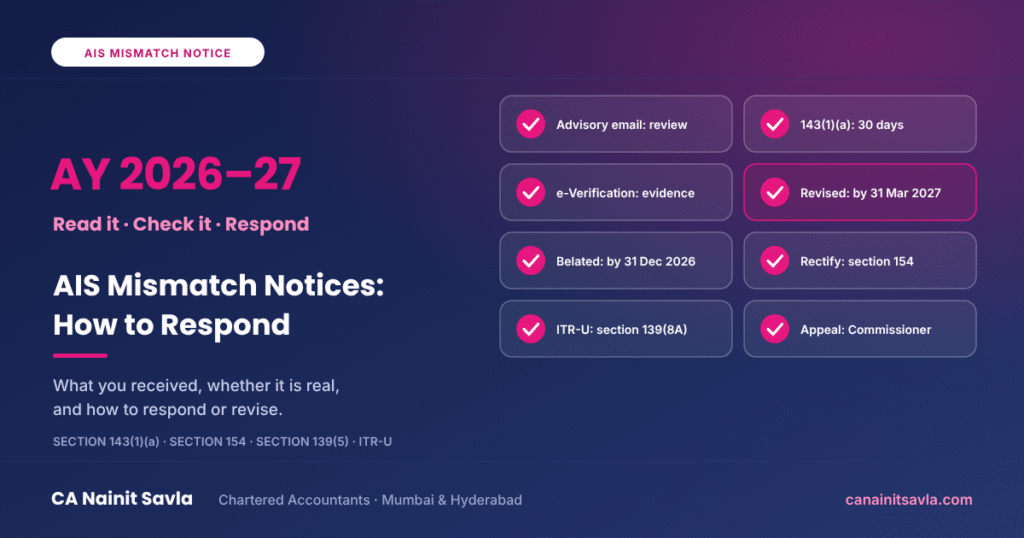
AIS Mismatch Notices for AY 2026–27: How to Read Them and Respond

🧾 Income Tax4 November 2026 · 8 min read Home›Blog›AIS Mismatch Notices for AY 2026–27 AIS Mismatch Notices for AY 2026–27: How to Read Them and Respond What you have received, whether the mismatch is real, and how to give AIS feedback, respond on the compliance portal, or revise your return. NSCA Nainit SavlaChartered Accountants, Mumbai & Hyderabad•Published 4 Nov 2026 AIS MISMATCH NOTICE AY 2026–27 Read it · Check it · Respond AIS Mismatch Notices: How to Respond What you received, whether it is real, and how to respond or revise. SECTION 143(1)(a) · SECTION 154 · SECTION 139(5) · ITR-U Advisory email: review143(1)(a): 30 dayse-Verification: evidenceRevised: by 31 Mar 2027Belated: by 31 Dec 2026Rectify: section 154ITR-U: section 139(8A)Appeal: Commissioner CA Nainit Savla Chartered Accountants · Mumbai & Hyderabad canainitsavla.com An AIS mismatch notice means the Income Tax Department’s records, reported by banks, employers, brokers and others in your Annual Information Statement, do not match what you declared in your return. For AY 2026–27, the response depends on what you received and whether the mismatch is real: Advisory email or SMS: review the AIS; if your return is wrong, revise it; if it is right, record feedback and keep your workings. Proposed adjustment under section 143(1)(a): respond within 30 days, or the adjustment is made. e-Verification or e-campaign on the compliance portal: respond with an explanation and evidence. Deadlines: belated return by 31 December 2026; revised return reported to be allowed up to 31 March 2027, with a fee from 1 January 2027. This guide from CA Nainit Savla, Chartered Accountants, explains each step. It is based on the law and published sources as of 4 November 2026. For the firm’s work in this area, see our income tax notices page. 📋 Key takeaways First identify what you received: an advisory, a 143(1)(a) proposal, an e-verification query or a formal notice. Not every mismatch is an error; reporting-entity mistakes are corrected through AIS feedback. If your return is wrong, revising it before the deadline is usually the cheapest fix. If the department’s processing is wrong, rectification under section 154 is usually the route, not a revised return. Ignoring a real mismatch can lead to a demand, interest, penalty or reassessment. What Kind of Communication Have You Received? ← Scroll to see the full table → Communication Where to see it What it requires Advisory email or SMS (“nudge”) about an ITR–AIS gap Email or SMS; details in AIS and the compliance portal Review; revise if wrong or record feedback; the department has said accurate filers can ignore it e-Campaign (for example on advance tax or significant transactions) Compliance portal, e-Campaign tab Review and respond with feedback e-Verification query (information call under section 133(6)) Compliance portal, e-Verification tab Explanation and evidence; can lead to closure, an updated return or reassessment Proposed adjustment under section 143(1)(a) e-filing portal, e-Proceedings, and registered email Agree or disagree within 30 days Intimation under section 143(1) with a demand Registered email and e-filing portal Pay, seek rectification under section 154, or appeal Reassessment notice under section 148 (after section 148A) e-Proceedings Formal reply within the stated time; professional advice recommended In March 2026 the department apologised for inaccurate “significant transactions” emails sent under its Advance Tax e-Campaign for AY 2026–27 and asked recipients to disregard them, so always check the portal before acting on an email. How Do You Check Whether the Mismatch Is Real? Download the AIS and Taxpayer Information Summary for FY 2025–26 from the e-filing portal, and Form 26AS for TDS and TCS. Find the flagged item and compare it with your return: the amount, the income head and the year. Check common reasons for a gap: interest on savings or fixed deposits, dividends, mutual fund and share sales, property purchases or sales, rent, foreign remittances, credit card spending and high-value cash deposits. Decide which applies: income missed in the return; income reported under a different head or netted against costs; a reporting entity’s error; or a transaction that is not yours. Keep supporting documents: bank and broker statements, contract notes, sale or purchase deeds and Form 16 or 16A. How Do You Respond on the Compliance Portal? The compliance portal is reached from the e-filing portal. AIS feedback is given against each item; published guides list these options: ← Scroll to see the full table → Feedback option When to use it Information is correct The item is right and is reflected in your return Information is not fully correct The amount or details are partly wrong; give the correct figure Information relates to other PAN / year Wrong PAN or wrong financial year Information is duplicate / included in other information The same transaction appears twice or within another item Information is denied You have no knowledge of the transaction; prompts a check with the reporting entity For an e-Verification query, respond in the e-Verification tab with an explanation and documents. Each submission generates an acknowledgement number; download and keep it. When Should You Revise or File an Updated Return? ← Scroll to see the full table → Situation Route Timing for AY 2026–27 Return not filed yet Belated return under section 139(4), with late fee under section 234F By 31 December 2026 Return filed but income missed or misreported Revised return under section 139(5) Reported to be allowed up to 31 March 2027; fee under section 234-I from 1 January 2027 Revision window missed; income to be added Updated return (ITR-U) under section 139(8A), with additional tax Generally within 48 months from the end of the assessment year Return right, processing wrong Rectification under section 154 Within the time limits for rectification Demand disputed on merits Appeal to the Commissioner (Appeals) Within the appeal time limit from the demand or order If you need help preparing a revised, belated or updated return, see our ITR filing page. ⚠️ Do not revise just to make the AIS matchThe AIS is information reported by third parties, and it can be

AIS Mismatch Notices for AY 2026–27: How to Read Them and Respond Read More »

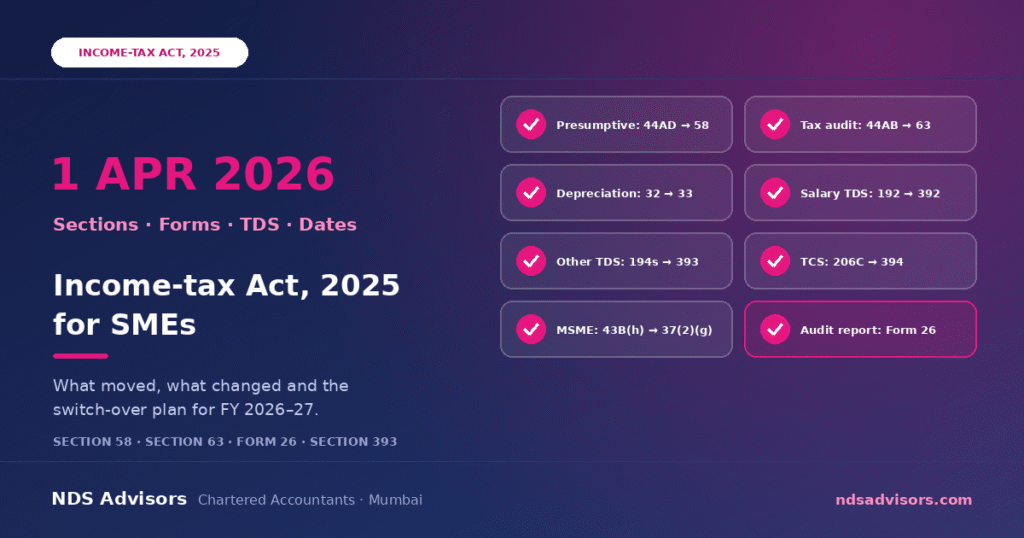
Income-tax Act, 2025 for SMEs: What Changed From 1 April 2026 and How to Switch Over

🧾 Income Tax3 November 2026 · 9 min read Home›Blog›Income-tax Act, 2025 for SMEs Income-tax Act, 2025 for SMEs: What Changed From 1 April 2026 and How to Switch Over What moved, what is new and how to switch over: tax year, section numbers, TDS codes, Form 26 and deadlines under the Income-tax Act, 2025. NDNDS AdvisorsChartered Accountants, Andheri (East), Mumbai•Published 3 Nov 2026 INCOME-TAX ACT, 2025 1 APR 2026 Sections · Forms · TDS · Dates Income-tax Act, 2025 for SMEs What moved, what changed and the switch-over plan for FY 2026–27. SECTION 58 · SECTION 63 · FORM 26 · SECTION 393 Presumptive: 44AD → 58Tax audit: 44AB → 63Depreciation: 32 → 33Salary TDS: 192 → 392Other TDS: 194s → 393TCS: 206C → 394MSME: 43B(h) → 37(2)(g)Audit report: Form 26 NDS Advisors Chartered Accountants · Mumbai ndsadvisors.com The Income-tax Act, 2025 replaced the Income-tax Act, 1961 from 1 April 2026, with the Income-tax Rules, 2026 notified on 20 March 2026. For SMEs in Mumbai and elsewhere, the substance is largely the same, but almost everything has a new reference: Tax year: one “tax year” replaces the previous year and assessment year; tax year 2026–27 is the first under the new Act. New section numbers: for example, presumptive taxation is now section 58, tax audit section 63, depreciation section 33, and most TDS sits in a table in section 393. New forms and codes: the tax audit report is Form 26, and TDS and TCS use new forms and tax codes. Some real changes: reported changes include a fixed fee for late tax audit reports, clearer deductibility of employees’ PF and ESI deposited by the return due date, and longer windows for revised returns. FY 2025–26 returns and audits stay under the old Act. This guide from NDS Advisors, Chartered Accountants, Mumbai, explains what moved, what changed and how to switch over. It is based on the law and published sources as of 3 November 2026. For the firm’s work in this area, see our income tax services page. 📋 Key takeaways From 1 April 2026: income is taxed under the 2025 Act; FY 2025–26 stays under the 1961 Act. Rates, presumptive limits, audit thresholds and most TDS rates carried forward, as reported. New references: section 58 (presumptive), 63 (tax audit), 33 (depreciation), 392 (salary TDS), 393 (other TDS), 394 (TCS). Form 26 replaces Forms 3CA, 3CB and 3CD for tax years from 2026–27. MSME payment rule continues as section 37(2)(g); update software, deeds and calendars now. Which Sections Have Moved? ← Scroll to see the full table → Topic (1961 Act section) 2025 Act section Note Presumptive taxation (44AD, 44ADA, 44AE) 58 Consolidated; one mapping gives 61, so confirm Tax audit (44AB) 63 Report in Form 26 from tax year 2026–27. See our income tax audit page Business deduction, general (37) 34 Payment-basis deductions (43B), including MSME (43B(h)) 37 (MSME at 37(2)(g)) No relaxation of the MSME rule, per Rajya Sabha reply of 21 July 2026 Disallowances for non-deduction of TDS (40(a)(ia)) 35 Cash payments (40A) 36 Depreciation (32) 33 New tax regime for individuals (115BAC) 202 Return of income (139) 263 Covers original, belated, revised and updated returns Salary TDS (192) 392 Other TDS (193 to 196D) 393 (table) Each payment type is a row; check the row number TCS (206C) 394 Mappings are from published concordances (TaxGuru and others) and are not official; check them against the Act and the Income Tax Department’s mapping utility before quoting them in filings or replies to notices. What Actually Changed for SMEs? Tax audit penalty: the old penalty for not getting accounts audited is reported to be replaced by a fixed fee of ₹75,000 for delays of up to a month and ₹1,50,000 beyond that. Employees’ PF and ESI: contributions credited by the return due date are reported to be deductible, removing a common tax audit adjustment. Returns: as reported, non-audit business returns are due by 31 August, audit cases by 31 October and transfer pricing cases by 30 November; revised returns may be filed within 12 months of the end of the tax year, and updated returns within 48 months with additional tax. See our business tax filing page. Partners: TDS at 10% is reported to apply to payments to partners above ₹20,000 a year, and partner remuneration limits carry forward. Companies: commentary reports that minimum alternate tax falls to 14% of book profit and that buy-back proceeds are again taxed as capital gains. ⚠️ Two laws run side by side for a whileFY 2025–26 income (AY 2026–27) is assessed under the 1961 Act on the old forms, and earlier assessments, appeals and reassessments continue under it. TDS follows the date of credit or payment: amounts credited up to 31 March 2026 use the old sections, and those from 1 April 2026 use the new ones. For AY 2026–27 audit cases, CBDT Circular 07/2026 extended the tax audit report date to 21 October 2026 and the return date to 21 November 2026. Keep both sets of references and files open until the old years are closed. How Should an SME Switch Over? ← Scroll to see the full table → Area What to update Why Accounting and payroll software TDS sections, tax codes, challan and statement formats, Form 16 equivalents. Confirm your TAN registration details Filings and deductions must use new references from 1 April 2026 Compliance calendar Return, audit, advance tax and TDS due dates under the new Act. Use our compliance calendar Some dates and windows changed Contracts and documents Section references in agreements, partnership deeds, board resolutions, bank and investor documents Old references can cause confusion or rejected forms Payables MSME payment tracking under section 37(2)(g); check each supplier’s Udyam registration The 45-day rule continues Payroll PF and ESI deposit timing; employee declarations Deductibility of employee contributions Tax audit Checklists for Form 26 and audit timelines New format from tax year 2026–27 Records Keep 1961 Act files for FY 2025–26 and earlier Old-year assessments

Income-tax Act, 2025 for SMEs: What Changed From 1 April 2026 and How to Switch Over Read More »

Input Tax Credit Under GST: How to Reconcile GSTR-2B and IMS Every Month (2026)

🧾 GST30 October 2026 · 10 min read Home›Blog›GSTR-2B and IMS Reconciliation Input Tax Credit Under GST: How to Reconcile GSTR-2B and IMS Every Month (2026) A five-step monthly routine for GSTR-2B and the Invoice Management System: the calendar, mismatch fixes, credit notes, Rule 88D and the 30 November 2026 cut-off. NSCA Nainit SavlaN D Savla & Associates, Chartered Accountants, Andheri East, Mumbai•Published 30 Oct 2026 INPUT TAX CREDIT 5 STEPS Review · Compare · Fix · File · Track GSTR-2B & IMS Reconciliation The monthly ITC routine, mismatch fixes, credit notes and the 30 Nov cut-off. RULE 36(4) · RULE 88D · SECTION 16(4) · 2026 By 14th: IMS actions14th: GSTR-2B readyMatch purchase books20th: GSTR-3B dueCredit notes: pendingRule 88D: DRC-01CBlocked: Table 4(B)(1)Cut-off: 30 Nov 2026 CA Nainit Savla Chartered Accountants · Mumbai canainitsavla.com Input tax credit under GST is now claimed through GSTR-2B, so reconciling it every month is the core of ITC compliance. The routine has five steps: Before the 14th, review each supplier record in the Invoice Management System (IMS) and accept, reject or keep it pending. Records left untouched are deemed accepted. When GSTR-2B is generated on the 14th, compare it with the purchase register. Fix mismatches with suppliers, and recompute GSTR-2B after any further IMS actions. File GSTR-3B. Table 4 is auto-populated from GSTR-2B; report blocked and temporary reversals separately. Track missing invoices, unpaid bills and credit notes into the following months. Since the October 2025 tax period, credit notes can be kept pending for one period, and you declare how much credit to reverse. Claiming more than GSTR-2B supports can trigger a Rule 88D intimation. FY 2025-26 credit must be claimed by 30 November 2026. This guide from CA Nainit Savla, Chartered Accountants in Mumbai, explains each step and is based on the law and published sources as of 30 October 2026. For the firm’s work in this area, see our GSTR-2B reconciliation and ITC review page. 📋 Key takeaways Rule 36(4): credit only on records in GSTR-2B; IMS actions decide what is in it. Untouched records are deemed accepted; review IMS before the 14th. Acceptance is not eligibility: blocked credits are accepted, then reversed in Table 4(B)(1). Credit notes: pending for one period; declare only the credit actually claimed. Deadline: claim FY 2025-26 credit by 30 November 2026. What Does the Monthly ITC Calendar Look Like? ← Scroll to see the full table → When What happens Your action By the 11th (13th for QRMP IFF) Suppliers file GSTR-1 or IFF; records appear in IMS Chase key suppliers who have not filed Up to the 14th IMS open for actions Accept, reject or keep pending; compare with purchase register 14th GSTR-2B generated; untouched records deemed accepted Download GSTR-2B; run the reconciliation 14th to GSTR-3B filing Further IMS actions allowed Correct actions, then recompute GSTR-2B 20th (22nd or 24th for QRMP) GSTR-3B due; Table 4 auto-populated Report reversals; file; actions for the period are frozen Following months Late uploads move to later GSTR-2B Track open items and claim within section 16(4) How Should Each Mismatch Be Handled? ← Scroll to see the full table → Mismatch Likely cause Action In books, not in IMS or GSTR-2B Supplier has not filed; wrong GSTIN; uploaded late Do not claim; follow up; claim when it appears In IMS, not in books Not your invoice; duplicate; goods not received Reject if wrong; keep pending if goods are still to arrive Different value, tax or rate Supplier error Reject; supplier corrects through GSTR-1A or an amendment IGST shown instead of CGST and SGST, or vice versa Wrong place of supply Reject; supplier amends Blocked item (section 17(5)) Correct invoice, ineligible credit Accept; reverse in Table 4(B)(1). See our ITC eligibility guide Supplier unpaid beyond 180 days Payment condition not met Reverse in Table 4(B)(2); reclaim on payment Credit note from supplier Discount, return or price change Accept and declare the credit to reverse, or keep pending for one period Reverse charge purchase Not routed through IMS Pay tax; claim in Table 4(A)(3) ⚠️ Inaction counts as acceptanceRecords left without action in IMS are deemed accepted when GSTR-2B is generated, including wrong or duplicate invoices and unwanted credit notes. Once GSTR-3B is filed, that period’s actions cannot be changed. If GSTR-3B credit exceeds GSTR-2B beyond the portal threshold, a Rule 88D intimation in DRC-01C follows, with seven days to pay or explain. How Do Credit Notes Work Now? From the October 2025 tax period, a recipient can keep a credit note pending for one tax period. When accepting it, the recipient states whether credit needs reducing: no reduction, the full amount or a stated amount. This means only the credit actually claimed on the original invoice is reversed. A supplier’s credit note reduces its own tax liability only when the recipient accepts it, so suppliers will follow up on rejected or pending notes. What Should the Reconciliation File Contain? Purchase register with supplier GSTIN, invoice number, date, taxable value, tax by head and posting period. GSTR-2B for the period, after recompute, and the IMS action log. Where older periods are involved, a GSTR-2A reconciliation working may also be needed. Matched items, and open items by type: not in GSTR-2B, rejected, pending, blocked, unpaid beyond 180 days. Supplier follow-up notes and expected filing dates. GSTR-3B Table 4 working, showing auto-populated figures, reversals and reclaims. 📝 NoteThis article is general information based on the law and published sources as of 30 October 2026. It is not professional advice. IMS features and portal rules change through GSTN advisories; consult a Chartered Accountant before claiming or reversing significant credit. What Should Be Finished Before 30 November 2026? Run a full-year FY 2025-26 reconciliation of books, GSTR-2B and GSTR-3B. Claim any eligible missed credit in the October 2026 GSTR-3B or another return filed by 30 November 2026. Clear pending credit notes and reverse credit on bills unpaid beyond 180 days. Keep the working papers for GSTR-9 and GSTR-9C, due 31 December 2026. What Should

Input Tax Credit Under GST: How to Reconcile GSTR-2B and IMS Every Month (2026) Read More »

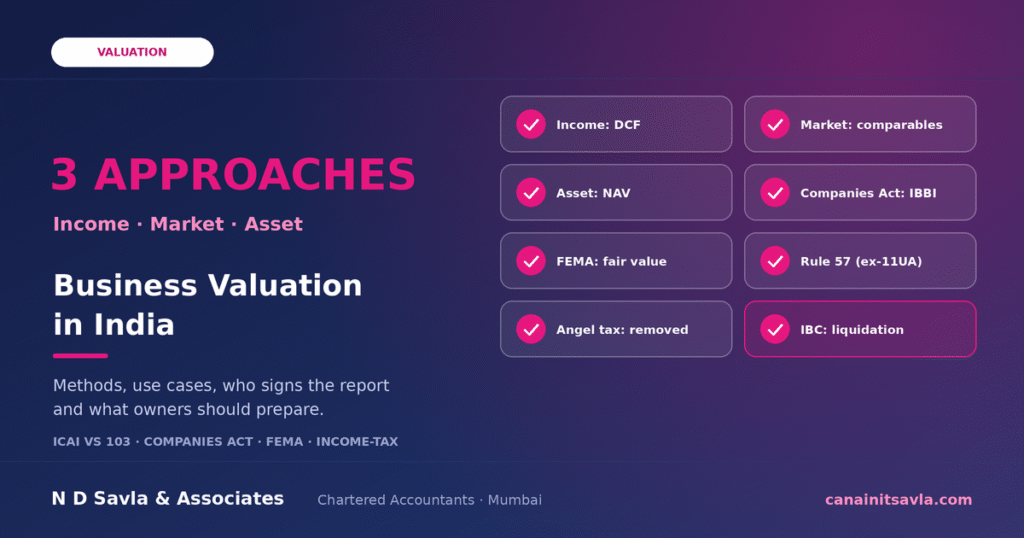
Business Valuation in India: Methods, Use Cases and What Every Owner Must Know

📈 Valuation26 October 2026 · 11 min read Home›Blog›Business Valuation in India Business Valuation in India: Methods, Use Cases and What Every Owner Must Know A plain-English guide to the three valuation approaches, when Indian law requires a valuation, who may sign it and how to prepare. NSCA Nainit SavlaN D Savla & Associates, Chartered Accountants, Andheri East, Mumbai•Published 26 Oct 2026 VALUATION 3 APPROACHES Income · Market · Asset Business Valuation in India Methods, use cases, who signs the report and what owners should prepare. ICAI VS 103 · COMPANIES ACT · FEMA · INCOME-TAX Income: DCFMarket: comparablesAsset: NAVCompanies Act: IBBIFEMA: fair valueRule 57 (ex-11UA)Angel tax: removedIBC: liquidation N D Savla & Associates Chartered Accountants · Mumbai canainitsavla.com Business valuation in India estimates what a company, business or its shares are worth on a specific date, for a specific purpose. Valuers use three approaches recognised in ICAI’s Valuation Standards: the income approach, chiefly discounted cash flow (DCF); the market approach, based on comparable companies or transactions; and the cost or asset approach, based on net asset value. Owners need a valuation for fundraising, mergers, share transfers, exits and succession, and Indian law often requires one: the Companies Act for preferential allotments, mergers and certain related-party deals; FEMA for share issues and transfers involving non-residents; income-tax rules for unquoted share transfers; and the IBC in insolvency. Who can sign the report, and which method applies, depends on the law in question. The Income-tax Rules, 2026, in force from 1 April 2026, renumbered the old Rule 11UA as Rule 57. This guide from CA Nainit Savla, Chartered Accountants in Mumbai, explains the methods, the use cases and how to prepare. 📋 Key takeaways Three approaches: income (DCF), market (comparables) and cost or asset (NAV); most reports use more than one. Companies Act valuations must be done by an IBBI registered valuer. FEMA: unlisted shares to non-residents at not less than fair value, certified by a CA, SEBI-registered merchant banker or practising cost accountant. Angel tax under section 56(2)(viib) no longer applies from AY 2025–26; Rule 11UA is now Rule 57 under the 2026 Rules. Purpose and valuation date drive the method, the signatory and the result. What Are the Main Valuation Methods? ← Scroll to see the full table → Approach Common methods Best suited to Income approach Discounted cash flow (DCF); relief from royalty and excess earnings for intangibles; option pricing models Profitable or growing businesses with reliable projections; startups when supported by market evidence Market approach Market price; comparable listed companies (multiples such as EV/EBITDA, P/E); comparable transactions Businesses with listed peers or recent comparable deals and funding rounds Cost / asset approach Net asset value (NAV); replacement or reproduction cost Asset-heavy, holding or investment companies, loss-making businesses, liquidation scenarios ICAI Valuation Standards, effective from 1 July 2018, set out these approaches in Valuation Standard 103 and apply to valuations under the Companies Act, 2013, while being recommendatory for valuations under other laws. A good report explains why each method was chosen, the key assumptions such as growth and discount rates, and how the results were weighed. How does DCF work? DCF projects the business’s free cash flows over a forecast period, usually five years, estimates a terminal value for the years after that, and discounts both to today using a rate that reflects the cost of capital and risk. Because the result depends heavily on projections, growth and discount rates, valuers typically test sensitivities and cross-check against market multiples. When Does Indian Law Require a Valuation? ← Scroll to see the full table → Law Common triggers Who signs Companies Act, 2013 Further issue of shares on a preferential basis (section 62(1)(c)); non-cash transactions with directors (section 192); compromises, arrangements, mergers and amalgamations (sections 230–232); purchase of minority shareholding (section 236) Registered valuer registered with IBBI (section 247 and the 2017 Registered Valuers Rules) FEMA (Non-debt Instruments) Rules, 2019 Issue or transfer of shares of an unlisted company to a non-resident (not less than fair value); transfer from non-resident to resident (not more than fair value). Read our guide to FEMA compliance for Indian startups for the filings that follow. Chartered Accountant, SEBI-registered merchant banker or practising cost accountant (for unlisted companies) Income-tax Act, 2025 and Income-tax Rules, 2026 Receipt or transfer of unquoted shares below fair market value (Rule 57, formerly Rule 11UA) Prescribed formula for unquoted equity; for some securities, a CA or SEBI Category I merchant banker report Insolvency and Bankruptcy Code, 2016 Fair value and liquidation value in insolvency; voluntary liquidation; asset sales in liquidation Registered valuers SEBI regulations Pricing of listed company issues, buy-backs and open offers As specified by SEBI What Changed for Tax Valuations in 2024–2026? Angel tax removed The Finance (No. 2) Act, 2024 made section 56(2)(viib) of the Income-tax Act, 1961, the “angel tax” on share premiums above fair value, inapplicable from assessment year 2025–26. Share issues from FY 2024–25 onward no longer face that charge, but earlier years can still be reassessed, and the genuineness and source of investment can still be examined under other provisions. New Act and Rules from 1 April 2026 The Income-tax Act, 2025 and the Income-tax Rules, 2026 took effect on 1 April 2026. According to practitioner commentary, the old Rule 11UA is now Rule 57 and works with the new provisions that replace sections 56(2)(x), 50CA and 28(via). For unquoted equity shares, the rule applies an adjusted net-asset formula, and the earlier DCF option is no longer available for those purposes. Quoted shares follow a market-price waterfall. For how the new Act affects your wider tax position, read our guide to tax planning for SMEs in Mumbai. ⚠️ ImportantTax valuation rules, FEMA pricing and Companies Act requirements differ in method, signatory and timing. A valuation prepared for one purpose may not satisfy another. This article is general information, not professional advice; confirm the requirements for your transaction with a qualified adviser. Which Business Situations Call for a Valuation? 🚀 Fundraising Setting

Business Valuation in India: Methods, Use Cases and What Every Owner Must Know Read More »

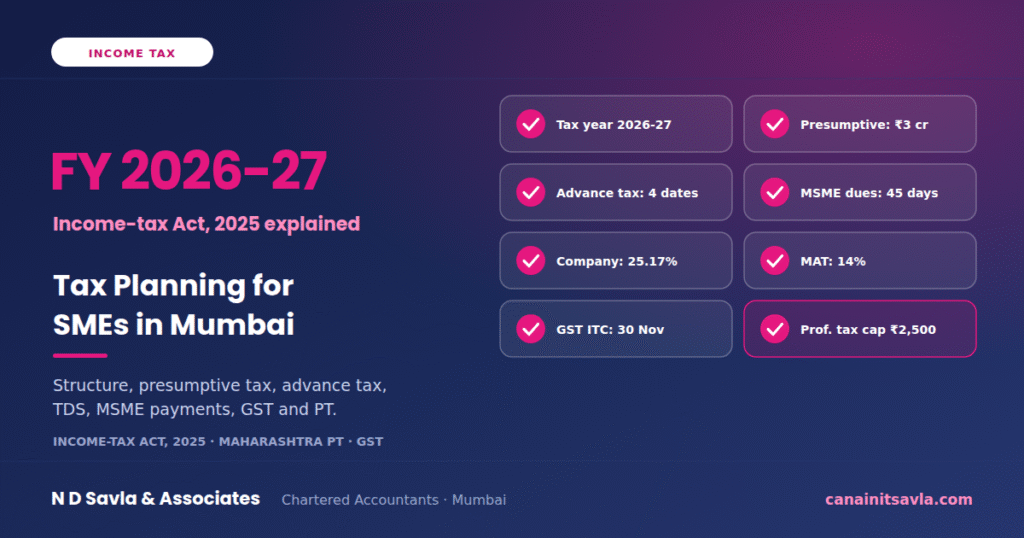
Tax Planning for SMEs in Mumbai: A Complete Guide for FY 2026-27

💰 Income Tax 23 October 2026 · 13 min read Home › Blog › Tax Planning for SMEs in Mumbai Tax Planning for SMEs in Mumbai: A Complete Guide for FY 2026-27 Tax planning for Mumbai SMEs in FY 2026-27: Income-tax Act 2025, entity choice, presumptive tax, advance tax, TDS, MSME payments, GST and professional tax. NS CA Nainit Savla N D Savla & Associates, Chartered Accountants, Andheri East, Mumbai • Published 23 Oct 2026 INCOME TAX FY 2026-27 Income-tax Act, 2025 explained Tax Planning for SMEs in Mumbai Structure, presumptive tax, advance tax, TDS, MSME payments, GST and PT. INCOME-TAX ACT, 2025 · MAHARASHTRA PT · GST Tax year 2026-27 Presumptive: ₹3 cr Advance tax: 4 dates MSME dues: 45 days Company: 25.17% MAT: 14% GST ITC: 30 Nov Prof. tax cap ₹2,500 N D Savla & Associates Chartered Accountants · Mumbai canainitsavla.com Tax planning for a Mumbai SME in FY 2026–27 means working within a new law. The Income-tax Act, 2025 replaced the 1961 Act from 1 April 2026, so FY 2026–27 is now “tax year 2026–27”, with renumbered sections, TDS rates set out in tables and new form numbers, while returns for FY 2025–26 are still filed under the old Act. The main levers are unchanged in substance: choosing the right business structure and tax regime, using presumptive taxation where it fits, timing advance tax, deducting TDS correctly, paying micro and small suppliers within 45 days, keeping cash transactions low and claiming GST input tax credit on time. Mumbai businesses also need to manage Maharashtra professional tax. This guide from CA Nainit Savla, Chartered Accountants in Mumbai, explains each lever, the key FY 2026–27 dates and a year-end checklist. Information is current to 23 October 2026 and is general guidance, not advice for your specific business. 📋 Key takeaways FY 2026–27 is tax year 2026–27 under the Income-tax Act, 2025; most rules carry over, but section and form numbers have changed. Companies pay 25.17% effective under the concessional regime, or 25% or 30% base rates plus surcharge and cess; MAT is 14% from tax year 2026–27. Presumptive taxation (section 58) suits small businesses and professionals with low cash receipts; the higher limits are ₹3 crore and ₹75 lakh. Advance tax is due on 15 June, 15 September, 15 December and 15 March; MSME dues unpaid beyond 45 days are deductible only when paid. Maharashtra professional tax, GST rate changes and the 30 November ITC deadline are part of a Mumbai SME’s tax calendar. What Changed With the Income-tax Act, 2025? From 1 April 2026, the Income-tax Act, 2025 governs income earned in FY 2026–27. The concept of “previous year” and “assessment year” is replaced by a single “tax year”. Many familiar provisions continue under new numbers, for example: ← Scroll to see the full table → Topic 1961 Act 2025 Act Presumptive taxation Sections 44AD, 44ADA, 44AE Section 58 Tax audit Section 44AB Section 63 Payment-basis deductions, incl. MSME dues Section 43B, 43B(h) Section 37, 37(2)(g) Depreciation Section 32 Section 33 Concessional company tax Section 115BAA Section 200 New regime for individuals Section 115BAC Section 202 Startup deduction Section 80-IAC Section 140 TDS on non-salary payments Sections 194C, 194J, 194-I and others Section 393 (rate tables) Return of income Section 139 Section 263 Published section mappings differ in places; confirm numbers against the enacted Act before quoting them in filings. Returns for FY 2025–26 and assessments of earlier years continue under the 1961 Act. Which Business Structure Is Most Tax-Efficient? There is no single answer; the right structure depends on profit levels, how profits will be taken out, funding plans and compliance capacity. The table summarises the headline positions for FY 2026–27. ← Scroll to see the full table → Structure How profit is taxed Points to weigh Proprietorship At the owner’s slab rates; new regime rebate means no tax up to ₹12 lakh of income Simple; unlimited liability; presumptive taxation available Partnership firm or LLP 30% plus surcharge and cess; partner’s share of profit exempt in their hands Remuneration and interest to partners deductible within limits; 10% TDS on partner payments above ₹20,000 Private limited company 22% concessional (25.17% effective) or 25%/30% plus surcharge and cess Dividends taxed again in shareholders’ hands; best for raising equity; MAT 14% outside the concessional regime Model the total tax, including salaries, partner remuneration and dividends, over three to five years before converting or choosing a structure. Our guide to TDS on dividends shows how distributions are taxed at source, and if you are still to incorporate, see how to register a private limited company in India. Should You Use Presumptive Taxation? Section 58 of the 2025 Act lets eligible resident businesses and professionals declare profit at a fixed percentage instead of maintaining full books and getting a tax audit. ← Scroll to see the full table → Who Limit Deemed profit Eligible business Turnover up to ₹2 crore, or ₹3 crore if cash receipts are within 5% of turnover 6% of receipts through banking or digital modes; 8% of other receipts Eligible professional Gross receipts up to ₹50 lakh, or ₹75 lakh if cash receipts are within 5% 50% of gross receipts Presumptive taxation suits businesses with good margins and mostly digital receipts. Two cautions: if you opt out within five years of using the scheme, you can be barred from it for the following five years, and the ITR-4 form now asks for balance-sheet items such as bank balances, debtors and creditors, so basic records are still needed. How Should You Plan Advance Tax? ← Scroll to see the full table → Due date Cumulative advance tax Planning point 15 June 2026 15% Base the first instalment on last year’s profit trend 15 September 2026 45% Revisit with six months of actual results 15 December 2026 75% Main true-up point for most SMEs 15 March 2027 100% (presumptive taxpayers may pay all by this date) Final adjustment after year-end projections Interest applies for shortfalls and late payment.

Tax Planning for SMEs in Mumbai: A Complete Guide for FY 2026-27 Read More »